THE HARMONY OF LANGUAGE
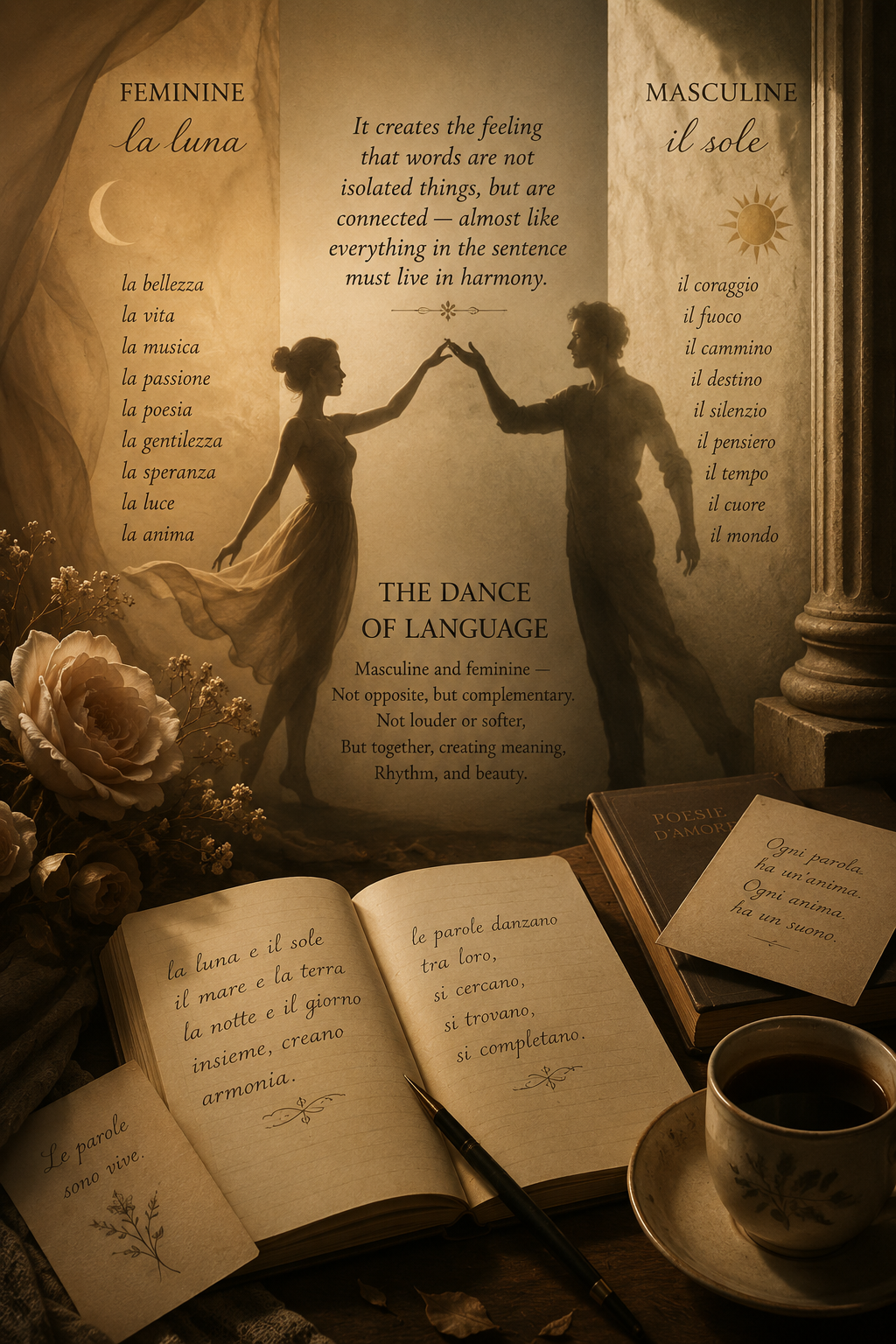
There is something beautiful in the way certain languages were shaped through the masculine and feminine, not only in people, but in the words themselves. I have always found that fascinating. How a language can carry softness and strength, movement and tenderness, almost without realizing it is doing so.
In languages like Spanish, French, Italian, and Portuguese, words are given masculine or feminine form, and somehow that alone changes the feeling of the sentence. The world itself begins to feel alive, almost relational. The sun is not simply the sun, the moon is not simply the moon. Even ordinary objects seem to carry personality, presence, and energy.
And perhaps without fully noticing, these languages romanticize life itself. Not always in the sense of romance between two people, but in the way they soften the edges of existence. They give rhythm to speech. They create a dance between masculine and feminine expression that moves through conversation naturally, almost musically.
There is poetry hidden inside of them. Not forced poetry, but inherited poetry. A language passed down through generations that still carries emotion in its structure.
Maybe that is why these languages often feel warm when spoken aloud. They do not simply communicate information. They seem to carry atmosphere. Feeling. Gesture.
I sometimes think language shapes the way people experience the world more than they realize. And perhaps in these languages, there remains a quiet reminder that life was never meant to be entirely mechanical or cold, but relational, expressive, and deeply felt.
The languages Spanish, French, Italian, and Portuguese are called the Romance languages, not because they were created to be romantic, but because they are descended from the language of the Roman Empire — specifically, Latin.
As the Roman Empire spread across different regions, people began speaking Latin in their own local ways. Over hundreds of years, the language has slowly changed depending on geography, culture, accents, invasions, and the natural evolution of speech. Eventually, what was once one language became many. In Italian
The moon is feminine—la luna
The sun is masculine—il sole
What is beautiful is how many cultures and poems naturally began attaching symbolism to this pairing. The moon often became associated with feminine qualities — intuition, reflection, softness, mystery, cycles, and emotion.
The sun became associated with masculine qualities — strength, constancy, visibility, warmth, direction, and illumination.
And in Italian especially, the words themselves sound musical when spoken together:
As I have always loved the sound of languages, seeing the words as masculine and feminine is truly interesting when you become aware of the word and its form, the feminine and the masculine within it. Yet, Italian was my first language, though this was never brought to my attention as I spoke the dialect taught to me by my parents and grandparents. It was simply spoken naturally, passed down through family, without explanation.
Later, when I studied the Italian language for my own growth, it became beautiful to see the language in this way, to recognize the structure and relationship within the words themselves. And yet, as beautiful as it was, it did not always make it easy to fully comprehend in the end. Perhaps because language is not only learned through rules, but through feeling, memory, sound, culture, and the life surrounding it.
Maybe that is why these languages often feel warm when spoken aloud. They do not simply communicate information. They seem to carry atmosphere. Emotion. Gesture.
I sometimes think language shapes the way people experience the world more than they realize. And perhaps within these languages, there remains a quiet reminder that life was never meant to feel entirely mechanical or cold, but relational, expressive, and deeply felt.
The dance between masculine and feminine words in languages is a constant balancing and responding within the sentence itself.
The words do not stand alone. They interact. They adjust to one another. They agree with one another.
If a noun is feminine, the article and adjective often become feminine too. If the noun is masculine, everything surrounding it shifts accordingly. The language moves in harmony, almost like partners in a dance.
For example, in Italian:
il ragazzo bello(the handsome boy)
la ragazza bella(the beautiful girl)
Notice how the article changes:
il → masculine
la → feminine
And the adjective changes too:
bello → masculine
bella → feminine
The sentence itself reshapes depending on what it is speaking about. That is the dance. Nothing remains rigid. The surrounding words respond to the identity of the word they are attached to.
Even beyond grammar, there is something symbolic that people feel within these languages. The masculine often carries a firmer, grounded sound, while the feminine can carry softness, openness, flow. When spoken aloud together, they create rhythm and contrast.
la luna
il sole
The softness of one beside the steadiness of the other.
And perhaps that is why these languages can feel romantic without trying to be. The structure itself mirrors relationship — not dominance of one over the other, but interaction, adjustment, complement, movement.
The masculine and feminine are continually acknowledging one another inside the language. One speaks, the other responds. One leads the sound, the other softens it. Together they create balance within expression itself.
It is almost as though the language understands something deeply human: that beauty often comes not from sameness, but from harmony between differences.
It creates the feeling that words are not isolated things, but are connected — almost like everything in the sentence must live in harmony, as though language itself understands that beauty is born when different forms learn how to move together.